
YANG-MILLS
We started as a small interior design firm in downtown Michigan, aiming to help home buyers make do with the new space that they had acquired. It soon became obvious that it would make sense to help our clients see beyond the walls and floor plans and be there with them from the get-go. Currently, we offer house realtor, interior design, and architecture services in order to help our customers find their forever homes as seamlessly and painlessly as possible.
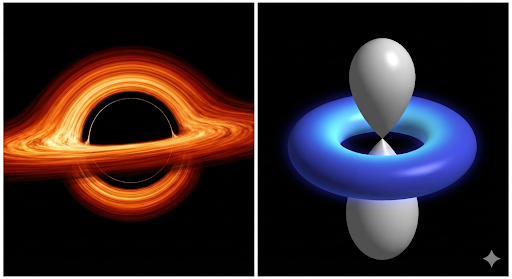
That is a fascinating connection to make, but the answer is no. The visual similarity between a black hole's accretion disk and an atomic orbital is not related to the "Yang-Mills" problem.
It sounds like you are thinking of the Yang-Mills existence and mass gap problem, which is one of the most famous and difficult unsolved problems in mathematical physics.
Here is a breakdown of the difference:
1. What We Were Discussing: A Visual Coincidence
Our previous conversation was about a visual coincidence. We established that a giant ring of matter around a black hole and a tiny probability cloud around an atomic nucleus can look similar in a diagram. However, they are fundamentally different phenomena, governed by different forces (gravity vs. electromagnetism) on completely different scales. There is no deep, unifying physics that makes them look the same; it's just that nature sometimes reuses simple shapes like spheres, disks, and rings.
2. The "Yang-Mills Thing": A Deep Mathematical Mystery
The Yang-Mills existence and mass gap problem is something else entirely. It is one of the seven Millennium Prize Problems set out by the Clay Mathematics Institute, and solving it would win you $1 million.
Here is a simplified explanation of what it's about:
Yang-Mills Theory: This is the mathematical framework that physicists use to describe the strong force (which holds atomic nuclei together), the weak force (responsible for radioactive decay), and electromagnetism. It is the foundation of the Standard Model of particle physics, which is our best theory of how the universe works at the smallest scales.
The Problem: Even though we use Yang-Mills theory every day to make incredibly precise predictions that match experiments (like at the Large Hadron Collider), we don't have a rigorous mathematical proof that the theory itself is sound. The problem asks for two things:
Existence: Prove that the equations of Yang-Mills theory actually have solutions that make sense in a four-dimensional spacetime (like ours) according to the strict rules of mathematics.
Mass Gap: Explain why the particles predicted by this theory (specifically for the strong force) have mass. The theory's basic equations seem to suggest that these particles should be massless, traveling at the speed of light. However, experiments show that the particles that transmit the strong force (gluons) bind together to form massive particles like protons and neutrons. There is a "gap" between having zero mass and having some positive mass. The problem is to prove mathematically why this gap exists.
In Short:
The black hole/orbital ring similarity is a fun visual coincidence with no deep physical meaning.
The Yang-Mills problem is a profound, unsolved mathematical question about the very foundations of our understanding of the universe's fundamental forces and why matter has mass.


Our team
Our strength lies in our individuality. Set up by Esther Bryce, the team strives to bring in the best talent in various fields, from architecture to interior design and sales.


Esther Bryce
Founder / Interior designer


Lianne Wilson
Broker


Jaden Smith
Architect


Jessica Kim
Photographer