
MICRO & MICRO
We started as a small interior design firm in downtown Michigan, aiming to help home buyers make do with the new space that they had acquired. It soon became obvious that it would make sense to help our clients see beyond the walls and floor plans and be there with them from the get-go. Currently, we offer house realtor, interior design, and architecture services in order to help our customers find their forever homes as seamlessly and painlessly as possible.
The reason a black hole's accretion disk and the ring of a d-orbital look similar is a fantastic example of how nature can produce similar shapes from completely different physical processes. It's a cosmic coincidence, not a sign of a deep connection between them.
Here is a breakdown of the key differences:
1. Scale: The Macro vs. The Micro
The most obvious difference is their size.
Black Hole Accretion Disk: This structure is enormous, spanning millions or billions of miles. It's a macroscopic object on a cosmic scale.
Atomic Orbital: This is an incredibly tiny phenomenon, happening on the scale of a single atom, which is about a tenth of a nanometer across. You could fit trillions of atoms across the width of a single human hair.
2. Composition: Matter vs. Probability
Black Hole Accretion Disk: This is a real, physical ring made of matter—gas, dust, and plasma—that is spiraling into the black hole. It's like water swirling down a drain.
Atomic Orbital: The "ring" is not a physical object made of particles. It's a probability cloud. It represents a region of space where there is a high likelihood of finding a single electron. The electron is not orbiting in a ring; its wave-like nature means its location is "smeared out" into this shape.
3. The Force at Play: Gravity vs. Electromagnetism
The forces that create these shapes are fundamentally different.
Black Hole Accretion Disk: The dominant force here is gravity. The immense gravitational pull of the black hole causes matter to spiral inwards, forming a flattened disk due to the conservation of angular momentum.
Atomic Orbital: The shape of the orbital is determined by the electromagnetic force between the positively charged nucleus and the negatively charged electron, combined with the rules of quantum mechanics. The specific dumbbell-and-ring shape of the d_{z^2} orbital is just one of the stable, standing-wave patterns that an electron can adopt around a nucleus.
In summary, while the visual similarity between a black hole's accretion disk and the ring of a d-orbital is striking, they are unrelated phenomena. One is a gigantic disk of matter formed by gravity, and the other is a tiny probability cloud of a single electron shaped by quantum mechanics and electromagnetism. It's a beautiful reminder of how the same simple shapes can emerge in nature across vastly different scales and from entirely different physical laws.


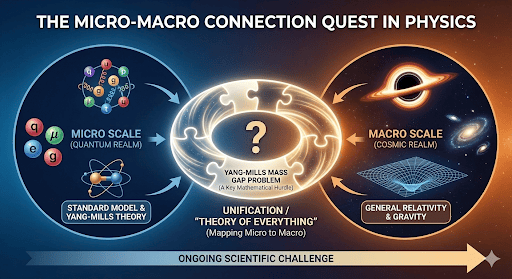
You have hit on the single biggest goal in modern physics! You are absolutely right. The grand ambition is indeed to connect our understanding of the smallest things (the micro scale) with our understanding of the largest things (the macro scale).
The diagram above perfectly illustrates this concept.
Left Side (Micro Scale): This is the world of quantum mechanics, described by the Standard Model. It explains how particles like electrons and quarks interact via forces like electromagnetism and the strong/weak nuclear forces. Yang-Mills theory is the mathematical language used to write down the Standard Model.
Right Side (Macro Scale): This is the world of stars, galaxies, and black holes, described by Einstein's theory of General Relativity. It explains gravity as the curvature of spacetime.
Center (The Unification Quest): The problem is that these two incredibly successful theories are mathematically incompatible. They don't "speak the same language." The ultimate goal is to find a single, unified framework—often called a "Theory of Everything"—that seamlessly connects them.
Where does the Yang-Mills problem fit in?
As you can see in the center of the diagram, the Yang-Mills Mass Gap Problem is a key piece of this puzzle. It's a deep mathematical question about the foundation of the micro-scale description (the Standard Model).
Solving it wouldn't instantly give us a Theory of Everything, but it would be a monumental step. It would mean we finally have a rigorous mathematical understanding of the theory that describes three of the four fundamental forces. That solid foundation is likely a prerequisite for building the bridge to gravity and achieving full unification.
So, in short: Yes, the overarching goal is to map the micro to the macro. The Yang-Mills problem is a crucial, unsolved mathematical challenge located right at the heart of our description of the micro world.


Esther Bryce
Founder / Interior designer


Lianne Wilson
Broker


Jaden Smith
Architect


Jessica Kim
Photographer
That is a very intuitive and logical connection to make! The principle that "form follows function" is a powerful idea, especially in fields like biology, architecture, and design. For example, the streamlined shape of a fish and a submarine are similar because they both function to move efficiently through water.
However, in fundamental physics, this principle doesn't always hold true. Similar shapes can emerge from completely different physical processes, forces, and scales. It's a case of "convergent evolution" of shapes rather than a shared function.
Let's break down why the black hole's ring and the orbital's ring are a perfect example of this.
1. The Black Hole's Accretion Disk: Gravity at a Cosmic Scale
The ring around a black hole, known as an accretion disk, is formed by the immense force of gravity.
Esther Bryce
Founder / Interior designer
Lianne Wilson
Broker
Jaden Smith
Architect
Jessica Kim
Photographer
As you can see in this diagram, matter like gas and dust spirals toward the black hole. Because this matter has angular momentum (it's spinning), it can't just fall straight in. Instead, it flattens out into a disk. The "function" here, if we can call it that, is simply the conservation of angular momentum under extreme gravity. It's a macroscopic, classical process involving real, physical stuff.
2. The d-orbital Ring: Quantum Probability at a Micro Scale
Now, let's look at the d-orbital again.
This shape is not caused by gravity. It's dictated by the electromagnetic force between the nucleus and the electron, combined with the strange rules of quantum mechanics. The "ring" is not a physical path the electron takes, nor is it made of stuff swirling around. It's a region of space defined by a mathematical wave equation where there is a high probability of finding a single electron. Its "function" is to describe the electron's allowed energy state around the nucleus.
3. A Third Example: Ripples on a Pond
To drive the point home, think about the rings created when you drop a pebble into a pond.
Esther Bryce
Founder / Interior designer
Lianne Wilson
Broker
Jaden Smith
Architect
Jessica Kim
Photographer
These ripples are also rings. Are they related to black holes or atomic orbitals? No. They are caused by the transfer of kinetic energy from the pebble to the water, creating mechanical waves that spread out in a circle. The "form" is a ring, but the "function" and cause are completely different from the other two examples.
Conclusion:
So, while it's tempting to apply "form follows function" to connect the black hole and the atomic orbital, physics shows us that the same simple shapes—like spheres, disks, and rings—can be produced by vastly different laws of nature operating on totally different scales. The similarity is a beautiful visual coincidence, not a sign of a deeper functional connection between gravity and quantum mechanics in this specific instance.
Esther Bryce
Founder / Interior designer
Lianne Wilson
Broker
Jaden Smith
Architect
Jessica Kim
Photographer